EEG-Based Alzheimer’s Disease Classification
Project Overview
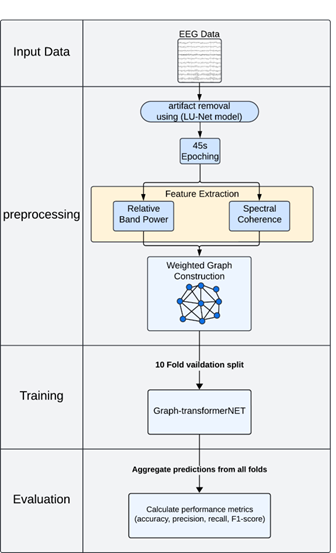
This project presents a novel graph-based transformer architecture for the classification of Alzheimer’s Disease and Frontotemporal Dementia using EEG signals. Developed as my Bachelor’s thesis, this work achieved 99.1% accuracy, significantly surpassing existing state-of-the-art methods by 7-18 percentage points.
Key Achievements
| Metric | Result |
|---|---|
| Classification Accuracy | 99.1% |
| Improvement over SOTA | 7-18 percentage points |
| Classes | Healthy, Alzheimer’s, Frontotemporal Dementia |
| Status | Under review at Journal of Neural Engineering |
Model Architecture
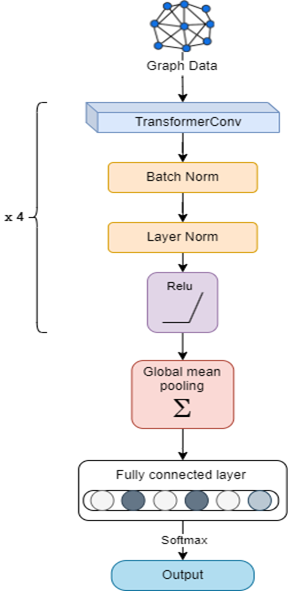
The framework integrates spatial and temporal EEG features using a custom graph-transformer design:
EEG Feature Visualization
Our approach leverages power spectral density (PSD) features across EEG frequency bands:
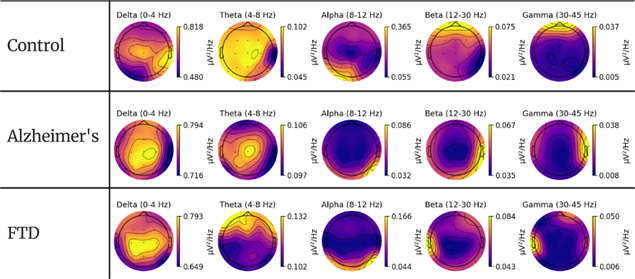
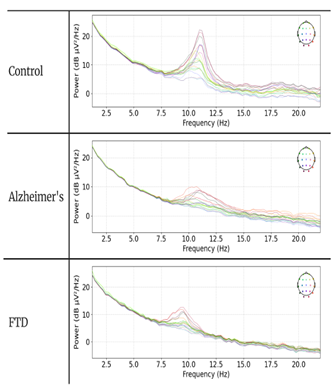
The analysis highlights distinct biomarkers distinguishing the three groups. The spatial heatmaps reveal localized changes in brain activity intensity, while the spectral plots demonstrate clear separation in power distribution frequencies—specifically showing how Alzheimer’s pathology alters lower-frequency band power compared to healthy controls.
Technical Implementation
- Graph Neural Networks: Custom graph transformer leveraging electrode spatial relationships
- Feature Engineering: Relative band power, spectral coherence across EEG frequency bands
- Signal Processing: Comprehensive EEG preprocessing and artifact removal
- Benchmarking: Systematic comparison of classical ML vs. deep learning approaches
Technologies Used
- Python, PyTorch, PyTorch Geometric
- scikit-learn, MNE-Python
- Signal processing: FFT, spectral analysis
Research Impact
This work demonstrates the potential of graph-based deep learning for biomedical signal processing. The significant improvement over existing methods suggests new directions for non-invasive Alzheimer’s diagnostics using routine EEG recordings.
Publication Status
Under Review at IOP Journal of Neural Engineering
First author — responsible for design, analysis, and drafting
Code Repository
github.com/yosftag1/eeg-alzheimer-classification
Project Timeline
September 2023 – June 2024 (Bachelor’s Thesis Project)
Supervised by: Dr. A. Eltrass, Dr. H. Farag